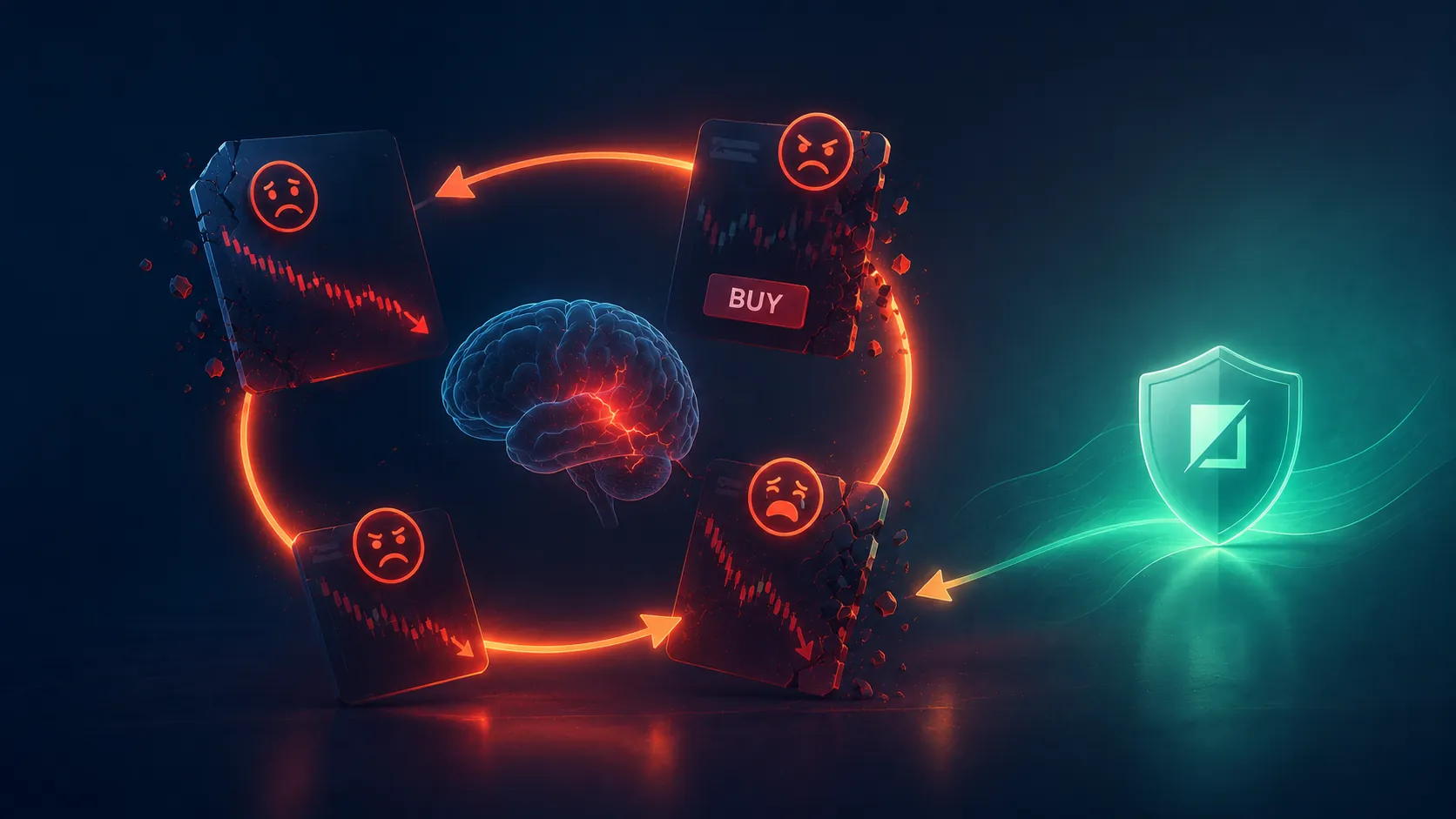
You take a loss and it stings more than it should. Within seconds you're back in the market with bigger size, no plan and a hot need to make it back right now. Twenty minutes later you're down three times the original loss and wondering what happened. That's the revenge trading loop. It's a predictable response rather than a character flaw, which means you can interrupt it.
Why your brain does this
Your brain doesn't file a trading loss as "a normal cost of business." It reads it as a threat. The amygdala, the part of your brain that handles fear and threat, fires before the rational, planning part even gets involved. Cortisol and adrenaline rise, your heart rate climbs and your focus narrows.
In that state you are not the same trader who wrote your trading plan. The prefrontal cortex, where discipline and patience live, gets sidelined, and you're running on a system that evolved to escape predators rather than manage risk on a chart. That's why "just be more disciplined" never works in the moment: the part of you that would be disciplined is offline.
The loop, step by step
- Trigger: a loss, especially one that feels unfair (a stop-hunt, a news spike, a winner that reversed).
- Surge: stress chemicals hit, and the loss feels like something you have to fix immediately.
- Action: you re-enter, usually bigger, usually without a setup.
- Outcome: the impulsive trade loses more often than not, which deepens the threat response.
- Escalation: the loop tightens. Each loss makes the next decision worse.
Notice that the loop feeds itself. Every turn raises the emotional stakes and lowers the quality of the next decision. Willpower alone rarely breaks it, because willpower is exactly the resource the stress response is draining.
The moment you most want to trade is almost always the moment you most need to stop.
How to actually break it
1. Decide your stopping point before you're triggered.
A daily loss limit is the strongest tool you have against revenge trading, but only if it's set in advance. "I'll stop if I'm down 2% on the day" is a decision your calm self can make. Your tilted self never will.
2. Put a wall between the impulse and the order.
The revenge trade happens in the few seconds after a loss. If you force a pause, such as a cooldown after a losing trade or a hard block on new orders, the surge passes and the rational brain comes back online. A few minutes is often enough.
3. Make the rule impossible to override.
This is the part most traders get wrong. They set a mental rule, then break it the moment it matters, because the override is one click away. If you can ignore a rule under stress, all you really have is a wish.
Where PipsGuard fits
PipsGuard's Emotional Trading Block and Loss Streak rules are built specifically for this loop. After a losing trade, or a string of them, PipsGuard can block new orders for a window you define, or pause trading for the rest of the session once you hit your daily loss limit. The pause no longer depends on willpower. By the time the cooldown lifts, the surge has passed and you're thinking clearly again.
Stop the loop before it costs you the account.
Set a cooldown after losses and let PipsGuard enforce it.
Get Started →